
What is vegan leather? Definition, manufacturing, advantages, and limitations
A comprehensive guide to this alternative to animal leather: materials, processes, environmental impact, durability, ethics, and care.
Our consumption habits are changing. We're eating less meat... To reduce our carbon footprint, for our health, out of conviction... The meat industry therefore produces fewer hides, and animal hides for leather production are becoming scarcer and more expensive. Alternatives to leather had to be found. Good news: the textile industry now offers a wide variety of them.
Following these innovations, fashion, always keen on new materials, is evolving, and with it, our consumption choices. More and more customers are looking for an alternative to animal leather for ethical or ecological reasons, or simply out of curiosity. Among these materials, vegan leather is taking a growing place. But what exactly are we talking about? How is it made? Is it plant-based? What are its advantages, its limitations, its real environmental impact?
In this guide, we answer all your questions about vegan leather: its definition, its different types (synthetic, bio-based, plant-based), French regulations on the word "cuir" (leather), its use in responsible fashion, its care, and the issues related to its production. Without greenwashing and maintaining an honest perspective on what this material can do... and what it cannot yet do.
Vegan leather: the simple definition
Vegan leather is an alternative material to animal leather, designed to mimic the appearance, texture, and sometimes the resistance of traditional leather, without any animal-derived elements. No skin, no hide, no animal glue, no animal-derived finish.
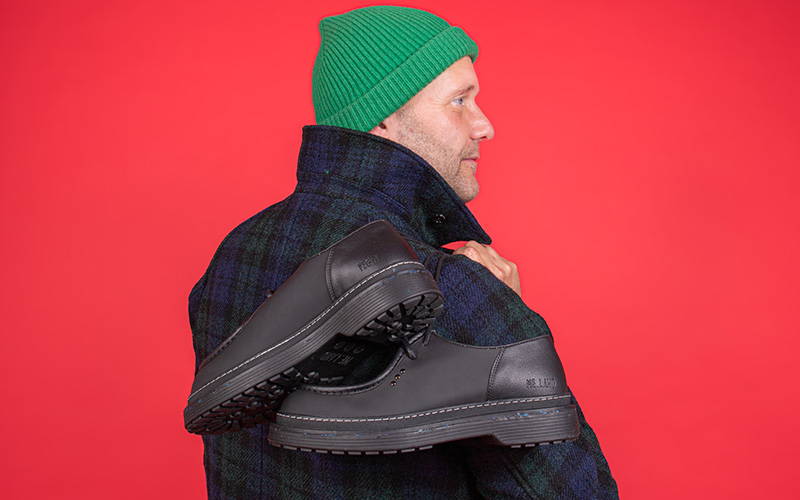
Unlike real leather, vegan material is made from synthetic products, bio-based materials, or plants. It is found in ethical leather goods (bags, belts, wallets), vegan footwear (sneakers, trainers, dress shoes, men's or women's styles), clothing, as well as in furniture and automobiles. These products all seek the same symbiosis: design and ethics.
The objective is twofold:
- to offer a cruelty-free material, respectful of animal life and animal welfare;
- to offer a solution that aligns with responsible fashion, ethical consumption, and more sustainable production.
The word "leather": what the regulations say
This is a point that few articles present clearly, and yet it is essential. In France, the Consumer Code reserves the term "cuir" (leather) solely for material obtained from an animal's skin through tanning or impregnation that preserves the natural form of the fibers. In other words: the expression "cuir vegan" (vegan leather) has no legal value in France. A material derived from plants or petrochemicals cannot legally bear the word "cuir", and phrases such as "cuir de pomme" (apple leather) or "cuir d'ananas" (pineapple leather) are, from the perspective of French law, incorrect but remain what you are looking for, hence they are commercial designations.
Note: this text has national scope and does not apply to articles legally manufactured in another European Union member state. Hence the coexistence of these designations on the market.
Furthermore, as of September 27, 2026, Directive (EU) 2024/825, known as "Empowering Consumers," becomes mandatory throughout the European Union. It prohibits unsubstantiated generic environmental claims ("eco-friendly," "eco-responsible," "carbon neutral" through offsetting) and requires that all advanced data be demonstrable, measurable, and verifiable. A new regulation that will undoubtedly clean up the discourse surrounding alternative materials.
Vegan leather, plant-based leather, vegan leather, synthetic leather: do not confuse
There is frequent confusion between these terms. Let's clarify, as the difference is significant:
- Traditional leather (or animal leather): animal skin transformed by a tanning process. Approximately 80% of global production uses chrome tanning, 10 to 15% uses vegetable tanning based on natural tannins.
- Vegetable leather: be careful, this is not a vegan material. It is animal leather tanned with natural tannins (wood, bark, fruit). The animal origin remains entirely intact.
- Imitation leather, faux leather, artificial leather, synthetic leather: all these words refer to the same family of imitation: a plastic material, usually PVC or polyurethane, applied to a textile backing.
- Vegan leather (or plant-based leather): an umbrella term that encompasses all alternatives to animal leather, whether synthetic or bio-based. All imitation leathers are therefore vegan leathers... but not all vegan leathers are equal.
How is vegan leather made?
The manufacturing of vegan imitation leather depends on the materials used. We distinguish two main families, plus a common assembly process.
1. Synthetic materials
The first vegan leathers were, and still are predominantly, made from synthetic products: PVC, and then especially polyurethane (PU), a type of plastic that is dominant today. These materials are widely used because they are affordable, offer a modern aesthetic, and have good durability.
Advantages: accessible, easy to produce, flexible, robust, available in all colors (black remains the classic).
Limitations: derived from petroleum, a limited resource, with a significant environmental impact and substantial chemical treatment.
One option to reduce this impact is the recycling of plastics from our daily collections, or even better, from marine plastic waste: this is the approach supported by initiatives like Seaqual Initiative. This does not, however, make the material a plant-based textile, but the use of existing resources benefits the planet.
2. Natural and bio-based materials
Textile innovation has made it possible to create new vegan materials based on natural fibers, plants, or cellulose. All of them valorize existing agricultural waste:
- Apple leather (AppleSkin): made from apple juice industry residues, sometimes combined with algae.
- Grape leather (Vegea): made from grape pomace, the residue from winemaking. A beautiful illustration of circular economy in an already structured French and Italian industry.
- Pineapple leather (Piñatex): produced from pineapple leaf fibers, resistant and breathable. It combines plant fibers, polylactic acid, and a polyurethane finish.
- Cactus leather (Desserto): made from nopal cactus fibers, a plant that requires very little water.
- Mushroom leather (mycelium), known as Mylo or Reishi: the most exciting promise of recent years, thanks to biofabrication techniques.
- Cork leather: made from the bark of the cork oak, harvested without felling the tree. Lightweight, waterproof, naturally biodegradable.
In full transparency, these materials reduce the proportion of fossil plastic but do not eliminate it. The truly bio-based content varies enormously from one product to another. It's around 65% for Piñatex Performance or 85% for apple leather, but only 16% for Desserto according to tests carried out by CTC, while the brand claims about two-thirds. The exact composition is often patent-protected and rarely fully disclosed. This is precisely the subject on which transparency must be demanded: the environmental benefit of a material directly depends on this percentage. For example, a "grape leather" composed of 20% pomace and 80% polyurethane remains, in fact, an imitation leather.
Another reality to be aware of: the mycelium industry has gone through a turbulent period. Mushrooms remain a promising avenue for the future, but the industrialization of these new materials takes time.
3. The assembly process
In the vast majority of cases, vegan leather is a multi-layer assembly:
- a textile base: cotton, coated jersey fabric, stretch fabric for uses requiring elasticity, or recycled polyester;
- a top layer of bio-based or synthetic materials, which provides the appearance and texture;
- a surface treatment designed to improve the quality, flexibility, water resistance, and durability of the material.
It is this composite structure that explains the main limitation of the material: an object made of several inseparable layers is very difficult to recycle at the end of its life.
What is the difference between vegan leather and animal leather?
| Criterion | Animal Leather (Traditional Leather) | Vegan Leather |
| Origin | Animal skin (mainly bovine), a co-product of the meat industry | Plants, agricultural waste, or petroleum - no animal products |
| Process | Tanning (chrome or vegetable) in a tannery | Coating, textile assembly, biofabrication |
| Lifespan | Very long, develops a patina over the years | Variable: from 2-3 years for low-end imitation to 10 years for quality material |