
How to choose your eco-friendly sneakers? The complete guide.
You want a pair that lasts, that you truly love, and that you can be proud of. On paper, everyone agrees. In practice, every brand promises the same thing: recycled materials, responsible fashion, reduced carbon footprint. Eco-friendly sneakers have become a fundamental trend, and with it, a profusion of offerings where everything looks alike. How do you differentiate between genuine commitment and a marketing ploy?
This comprehensive guide provides you with a concrete purchasing method: the criteria that truly matter, a quick checklist to keep in mind when looking at a pair, materials to prioritize, greenwashing signals to spot, and questions to ask before validating your cart. The key isn't to know everything, but to know what to look for. Shall we begin?

Why choosing eco-friendly sneakers is worth it?
A sneaker typically has about sixty components assembled in several countries. The dominant fast fashion model pushes for quick, distant, and mass production: cheap synthetic materials, long-distance transportation, rarely documented working conditions, short lifespan. The problem isn't the shoe itself, but the rate at which we replace it.
An eco-friendly sneaker reverses this logic in three ways:
✅ Environmental: recycled or bio-sourced materials that avoid extracting new resources and reduce the environmental impact of production.
✅ Human: an identified manufacturing location, fairly paid artisans, verifiable working conditions.
✅ Temporal: a product designed to last, be repaired, and whose end-of-life is anticipated from the design stage.
Consuming less but better is not just a slogan: it's the only truly effective leverage at the consumer level. A pair worn for three years has a carbon footprint per use three times lower than the same pair worn for one year.
The 7 selection criteria for choosing ethical sneakers
Here is the framework to apply, in order. No single criterion is sufficient on its own: it's their combination that guarantees a consistent choice.
1. Materials: the foundation of everything
The first reflex is to look at the composition, not the color. A model made of certified organic cotton canvas is completely different from the same model made of virgin polyester, even if they look similar on the shelf. Recycled and plant-based materials are the cornerstone of a truly durable pair (we detail each material below).
The point of vigilance: a brand that announces "recycled materials" without specifying which ones or in what proportion. 5% recycled plastic in the lining does not make a responsible sneaker.
2. Production location and short supply chains
The manufacturing location is the easiest information to verify and the most revealing. A committed brand displays it; an evasive brand talks about "selected partners" without ever naming a country.Look for two levels of information: where the shoe is assembled, and where the materials come from. A model assembled in Europe with materials imported from Asia is far from a short supply chain. Conversely, local sourcing, within a few tens of kilometers around the workshop, massively reduces transport emissions.3. Working conditions
An ethical sneaker is, first and foremost, a sneaker manufactured under decent conditions. Look if the brand mentions audits, fair wages, a long-term relationship with its workshops. References to fair trade and fair trade standards are a good sign, provided they are documented and not just mentioned.
A family workshop in Europe, subject to European labor law, inherently offers more guarantees than an anonymous factory on the other side of the world. Respect for people is an integral part of the approach, just like respect for the environment.
4. Labels and certifications
Certain certifications guarantee the quality and commitment of brands. Among the main labels:
- PETA-Vegan Approved- 100% animal-free and cruelty-free sneakers.
- OEKO-TEX - guarantees the absence of harmful substances in textiles.
- GOTS (Global Organic Textile Standard) - the reference for organic cotton, with a social component on working conditions.
- REFASHION - the eco-organization of the French textile industry, which manages the end-of-life of articles.
- SEAQUAL INITIATIVE - certifies the use of plastic recovered from the sea with product traceability.

The absence of a label does not condemn a brand, especially a small business for which certification is expensive. However, a brand that invents its own in-house label deserves closer scrutiny.
5. Real durability and comfort
This is the most often overlooked yet decisive criterion: an ecological shoe you don't wear is waste in the making. Check the quality of the assembly, the hold of the rubber sole, the support of the heel counter, the removable insole. A comfortable pair is a pair that will be worn, and thus amortized.
Also carefully test the size: half of returns from online stores come from a wrong size choice, and each return adds a round trip of transportation. Read reviews on the fit before ordering, and don't hesitate to write to customer service for more information.
6. End-of-life and reparability
A serious brand considers the product's entire life cycle. Specifically: is the model disassemblable? Can the materials be separated for recycling? Is there an offer for resoling, care, or take-back? A product that is recyclable on paper but impossible to disassemble will never actually be recycled.
7. The selling price and what it says
A pair manufactured in Europe with traceable materials costs, for comparable quality, between €130 and €230. Below €60, the numbers don't add up: someone is paying the difference, and it's neither the planet nor the shareholder.
This price should be considered in terms of cost per wear, not the displayed price. A €180 pair worn for four years is cheaper than three €60 pairs replaced every year and has three times less impact on the environment. If you're giving a gift, a gift card avoids size errors and the associated returns.
Which materials for responsible sneakers?

One innovative material transformed the shoe industry in a few years, and several others have followed. Here are the ones that deserve your attention:
Recycled plastic and marine nylons
Nylons made from plastic recovered from the sea (bottles, fishing nets, packaging) create a technical, light, and resistant fabric, without extracting new petroleum. The SEAQUAL label ensures traceability throughout the chain, from sea collection to the finished product. This is one of the rare cases where recycling solves a problem both at the input and output.

Organic cotton and hemp
Organic cotton is grown without pesticides and uses much less water than conventional cotton. It is ideal for laces and certain fabrics. Hemp goes even further: it grows without irrigation, without treatment, and yields a very strong fiber. Thanks to the GOTS certification, you can check the certification at a glance, on laces as well as on the fabric.
Natural rubber and recycled rubber
A recycled rubber sole made from production scraps, plastic stoppers, cork, or shredded tires is much more desirable for the planet than a virgin plastic sole. Industrial waste becomes raw material, and the recycling process consumes little energy.
Materials to avoid
PVC tops the list: difficult to recycle, loaded with toxic additives. Virgin polyester and chrome-tanned leathers without certification follow closely. Also pay attention to glue: many shoe glues contain animal derivatives or aggressive solvents. Alternatives based on natural latex exist and work very well while preserving living beings.
Why choose vegan sneakers?
A vegan sneaker contains no animal materials: no leather, no wool, no silk, no animal-derived glue. The reasons for making this choice are cumulative:
- Livestock farming has a heavy impact: the FAO estimates it accounts for about 14.5% of global greenhouse gas emissions. A vegan pair removes this item from the equation.
- Tanning pollutes: about 85% of global leather is chrome-tanned, a process that is among the most polluting for water and soil.
- Animal welfare: for some consumers, this topic is enough on its own.
- Material innovation: plant-based and recycled alternatives are progressing faster than traditional processes.
One nuance, however: vegan does not automatically mean ecological. A vegan PVC sneaker produced on the other side of the world remains a poor environmental choice. It's the intersection of the two logics. Vegan and responsible materials and traceable production make the difference.
How to reduce the carbon footprint of your sneakers?
The carbon footprint of a pair is determined by four factors, and you have control over each.
1. Production location. A shoe handmade in Portugal or Spain travels a few hundred kilometers to you, compared to over ten thousand from Southeast Asia. For transportation alone, the difference is undeniable. Prioritizing European manufacturing is the simplest action to reduce your wardrobe's carbon footprint.
ME.LAND, for example, manufactures its sneakers in Portugal and sources its materials within a 20 to 50 km radius of the workshops.

2. Material supply chain. A brand that sources its materials within a 50 km radius of its workshop eliminates an entire layer of invisible logistics. This is where a large part of the true environmental impact is hidden.
3. Lifespan. The most powerful lever, and the only completely free one. Maintaining, waterproofing, resoling, replacing laces instead of the entire pair: every additional month of wear dilutes the initial footprint.
4. End-of-life. Donating, reselling, dropping off at a collection point rather than discarding. A pair that gets a second life avoids new production.
One last thing, valid for any purchase: order all at once rather than in three separate packages. Grouped delivery costs are not just a matter of price.
How to recognize ethical sneakers: the quick guide
When looking at a pair, whether in a store or on a website, five checks are enough to form a solid opinion.
The 5 questions to ask a brand
- Where? The country of origin, France, Portugal, Spain, or elsewhere, must be clearly indicated, ideally with the name or region of the workshop.
- With what? Detailed composition, material by material, with percentages.
- Certified by whom? Verifiable third-party labels, not an in-house logo.
- And after? What the brand offers for repair, recycling, or take-back at the end of life.
- How much? A price consistent with the promises made.
Also check the label: European footwear marking identifies the materials of the upper, lining, and outsole with pictograms. This is the only physical clue available, and it doesn't lie.
Greenwashing signals
Certain indicators should alert you:
- Vague vocabulary: "eco-designed," "environmentally friendly," "committed," without a single figure to back it up.
- A "green" collection of three models amidst a catalog of two hundred classically produced items.
- A "our commitments" page that talks about the future in the future tense and never about the present.
- A label invented by the brand itself.
-
Permanent 50% discounts: producing at that price and paying fairly is not compatible.
Which eco-responsible sneaker brands to choose?
Rather than a ranking that will quickly become outdated, here are five signals that consistently distinguish a truly committed brand from one that simply communicates. Apply them to any brand, and you'll know what you're dealing with.
Documented transparency. The website names the workshops, materials, certifications, and publishes its limitations as well as its successes.
Catalog consistency. All production meets the same requirements, not just a marketing capsule.
Product traceability. Each pair can be linked to its batch of material and its place of manufacture.
Long-term commitment. A brand that has been producing locally for years, with the same artisans, has made structural choices, not circumstantial ones.
After-sales service. Maintenance advice, spare parts: a sign that they're not trying to sell you a new pair in six months.
This selection grid applies well beyond footwear. Responsible alternatives are now available in almost all categories: men's and women's clothing, jackets, fashion accessories, bags, beauty and hygiene products, bath linen, tableware, children's games and gifts, indoor and outdoor furniture. More and more brands offer them, and the same questions apply everywhere. Specialized stores, often called vegan shops or eco shoe stores, bring together a good portion of them.
Made in France or made in Europe: which to choose?
Many are looking for "Made in France" sneakers. Let's be factual: the French sneaker industry has almost disappeared, and the few models actually assembled in France most often use imported materials or sub-assemblies. A shoe designed in France and manufactured in Portugal or Spain, with traceable European materials, is often more virtuous than a "French-stamped" model where only the final stage is local.
The right approach is therefore not to look for a flag, but to consider the whole picture: design, production location, origin of materials, social conditions. Portugal, particularly the Porto region, has long-standing footwear expertise, family workshops, and a European social framework. It's a solid choice, not a compromise.
ME.LAND: what a well-designed eco-responsible sneaker looks like
To make all this concrete, here's how the French brand ME.LAND addresses, point by point, the grid presented above.
- Design and manufacturing: designed in Paris, the pairs are handcrafted in Portugal, in an audited artisanal and family workshop near Porto.
- Short supply chain: 100% of materials are European and sourced within a 50 km radius of the workshop.
- Materials: nylons made from recycled marine plastic, organic cotton, soles made from rubber scraps mixed with PET bottle caps, 100% natural plant-based latex glue, upcycled denim or certified ethical leather.
- Labels PETA VEGAN APPROVED, SEAQUAL INITIATIVE, OEKO-TEX, REFASHION and LEKO.
- End-of-life: models are designed to be disassembled and recycled; packaging is made of recycled cardboard and cotton pouches.
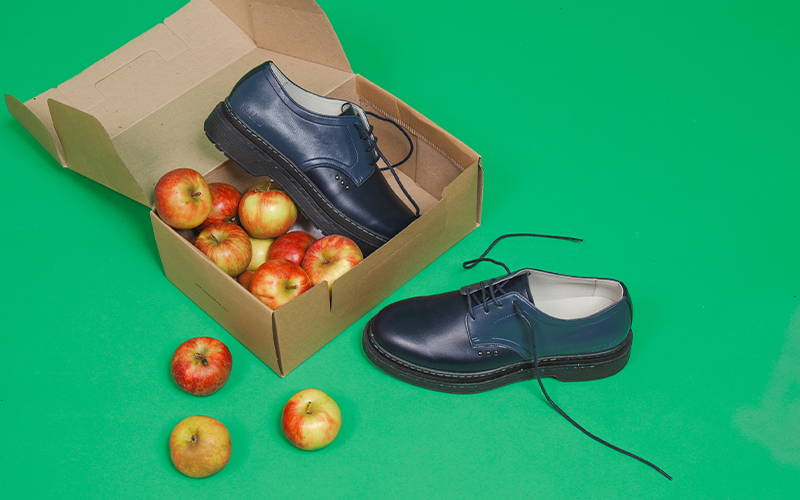
In terms of style, the brand offers vegan sneakers and models that can be worn daily without looking like technical sports products: the VIVACE and EVAN sneakers in recycled nylon or upcycled denim, the MEAKER and HEAKER models in leather from the food industry, and the derbies, loafers, and Chelsea boots in apple leather for a more chic look. A stylish pair remains a worn pair, and that's the whole point.
Free delivery in France and across Europe for purchases over €80, secure payment, and a 10% discount when subscribing to the newsletter on the online store.


Frequently Asked Questions
What is the difference between vegan sneakers and eco-responsible sneakers?
Vegan sneakers exclude all animal materials. Eco-responsible sneakers aim for a reduced environmental impact throughout their life cycle: materials, production, transport, end-of-life. The two often overlap but are not interchangeable. A vegan shoe can be polluting, and a shoe made from recycled leather can be virtuous.
How much does a pair of eco-responsible sneakers cost?
Expect to pay between €130 and €230 for a model made in Europe with certified materials. This selling price reflects the true cost of production that respects the environment and the people who make it.
Are eco-responsible sneakers comfortable?
Yes, and often more so than the market average: small-batch production allows for quality control that mass production does not. Simply check the insole and fit, as you would for any shoe.
How can I extend the life of my sneakers?
Alternate pairs to allow materials to dry, clean by hand with lukewarm water rather than in a machine, use appropriate care products for the material, and replace laces or soles rather than the entire pair.
What should I do with my sneakers at the end of their life?
If they are still wearable, donate or resell them. Otherwise, drop them off at a REFASHION textile collection point: the materials will be recycled rather than incinerated. The zero-waste goal starts there.
Key takeaways
Choosing eco-responsible sneakers doesn't require expertise. You need to ask five questions, read a label, and accept that a fair price pays for fair work. The rest: style, comfort, durability, naturally follow when the brand's approach is sincere. What matters, ultimately, can be summarized in one sentence: an eco-responsible sneaker is a pair whose history can be traced.
By choosing a pair designed locally, with recycled or plant-based materials, you reduce your footprint, support artisans, and buy a product that will last for years. This is the exact opposite of fast fashion, and it's within everyone's reach.
Discover the complete collection of ME.LAND eco-responsible sneakers as well as our vegan shoes and take the first step towards more responsible consumption.